
Key takeaways
- Side channel attacks can expose sensitive cryptographic information through physical device leakage.
- Masking is one of the most effective countermeasures against side channel attacks.
- ML-DSA (Dilithium) is difficult to mask efficiently due to expensive mask conversions.
- PQShield designed Raccoon to make high-order masking significantly more practical.
- Raccoon delivers substantial performance improvements over masked Dilithium.
Understanding side channel attacks
In 2022, NIST unveiled the first schemes selected to be NIST PQC standards: Kyber for key encapsulation (ML-KEM), and Dilithium (ML-DSA), Falcon, and SPHINCS+ (SLH-DSA) for digital signatures.
The security of these schemes has been extensively studied, and the community is confident in their mathematical foundations (lattices and hash functions). However, when deploying them one should pay special attention to side channel attacks.
What are side channel attacks?
When a physical device executes an algorithm, it may physically leak information about the type of operation, or the data being processed.
For example, a computationally expensive operation may drain the battery of your smartphone or heat it up. This leakage can manifest via other forms, such as the running time, electromagnetic emissions, or acoustic emission of the device. Sometimes, even the distant flickering of an LED can be exploited (Ars Technica).
The umbrella term side channel attacks (SCA) encompasses all attacks that leverage such leakage to compromise sensitive data.
How side channel attacks exploit physical leakage
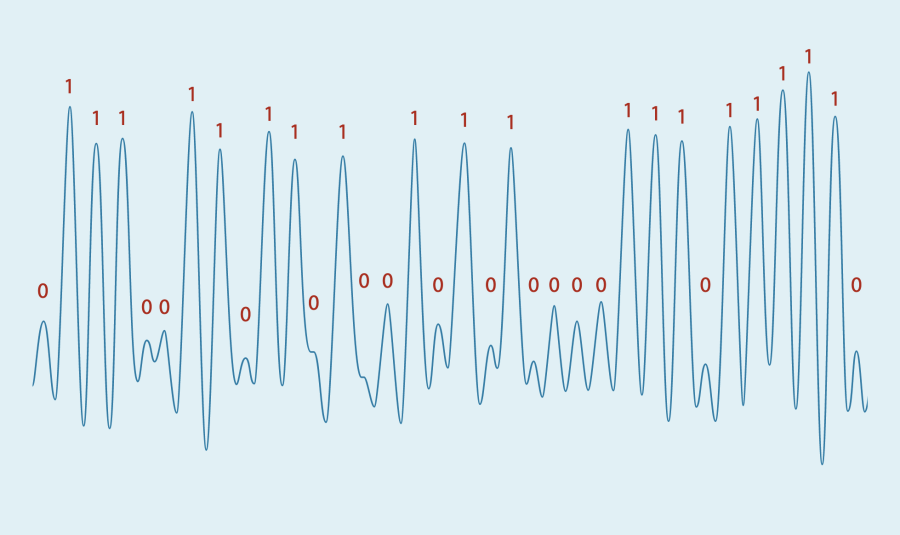
This simplified example from a research paper (ACM) displays the electric potential of a laptop using an RSA private key to decrypt a message. We can see a clear correlation between the bits of the private key (in red) and the signal being measured (in blue).
Post-quantum schemes are no less vulnerable to SCA than their classical counterparts. For example, several SCA attacks have been demonstrated against Dilithium (PQCrypto, TCHES). It is vital to adopt countermeasures against SCA.
Defeating SCA with masking
There exist many ways to mitigate SCA. I will focus on masking, since it is the most studied countermeasure, as well as one of the most generic, most effective, and most common. Masking consists of splitting each sensitive variable into d random shares, such that adding all shares recovers the variable.
For example, consider x = 9 in ℤ16, where ℤ16 is the ring of integers modulo 16. A valid masking of x with 3 shares would be (12, 5, 8), since (12 + 5 + 8) mod 16 = 25 mod 16 = 9.
The idea behind masking is that sensitive data is distributed across several shares, making it harder for an attacker to simultaneously learn the values of all shares. Experiments and analyses show that when masking with d shares, the cost of an attack increases exponentially in d. This gives us a reason to set d as high as possible.
The challenge of masked operations
The hard part, however, is that we need to be able to perform useful operations on masked data. Some operations are easy to perform.
Addition modulo q is one of them: (12, 5, 8) is a valid sharing of 9, (7, 2, 10) is a valid sharing of 3, and one can see that ((12 + 7) mod 16, (5 + 2) mod 16, (8 + 10) mod 16) = (3, 7, 2) is a valid sharing of 9 + 3 = 12. Note that this only requires d additions in the ring ℤ16, so masked addition is an efficient operations.
More generally, linear operations (including multiplying a masked vector by a matrix) are easy to mask efficiently. However, not all operations are easy to mask.
Why masking Dilithium is difficult
Now, let us have a look at the Dilithium signature scheme. We use bold lowercase notation for vectors (s, w, r, z), and bold uppercase for matrices (A). In Dilithium, the private key is a short vector s and the public key is the pair (A, t = A ⋅ s), where A is a large, random matrix. The signing procedure, very simplified, goes as follows:
- [Sample] Sample a short secret vector r
- [Linear] Compute a commitment w = A ⋅ r
- [Decompose] Decompose w in its high-order and low-order bits: w = w0 + 2k ⋅ w1.
- Compute a challenge c = H(msg, w1)
- [Linear] Compute a response z = c ⋅ s + r
- [Reject] If z is not in a given interval S, go to step 1.
- Output the signature sig = (c, z)
Research has shown that Steps 2 and 5, the linear operations, can be masked efficiently.
The remaining steps, Step 1 (Sample), Step 3 (Decompose) and Step 6 (Reject), all manipulate sensitive data and therefore need to be masked. However, these operations are much more difficult to implement efficiently.
Arithmetic versus Boolean masking
To understand why Steps 1, 3 and 6 are problematic, we need to introduce Boolean masking. The definition of masking that I introduced earlier is called arithmetic masking, because we work in the arithmetic ring (ℤ16, +).
However, nothing prevents us from using the binary representation of numbers instead, and to do all operations in the Boolean ring ((ℤ2)4 , ⊕), where ⊕ is the binary xor operator. For example, the binary representation 9 is 1001, and a valid masking of 1001 in (ℤ2)4 is (0101, 0010, 1110) since 0101 ⊕ 0010 ⊕ 1110 = 1001. This type of masking is called Boolean masking.
Switching between arithmetic and Boolean masking is called mask conversions, and is an expensive operation, so we would like to avoid it.
Why the Decompose step is challenging
Back to Dilithium, let us consider the step [Decompose]. Decomposing a number in its high-order bits and low-order bits is a simple computation or example, 9 = 1 + 22 ⋅ 2.
Bit-decomposition commutes with Boolean masking: the bit-decomposition of a Boolean masking is also a Boolean masking of the bit-decomposition. For example, if we decompose (0101, 0010, 1110) in its high-order bits (01, 00, 11) and low-order bits (01, 10, 10), we can see that 01 ⊕ 00 ⊕ 11 = 10 and 01 ⊕ 10 ⊕ 10 = 01. The bitstrings 10 and 01 are indeed the binary representations of the decomposition of 9 (2 and 1).
Unfortunately, there does not seem to be an easy way to compute [Decompose] in arithmetic masked form efficiently. As of today, the best-known approach is to switch from arithmetic to Boolean masking using a mask conversion, then perform [Decompose] in this representation.
Why mask conversions impact performance
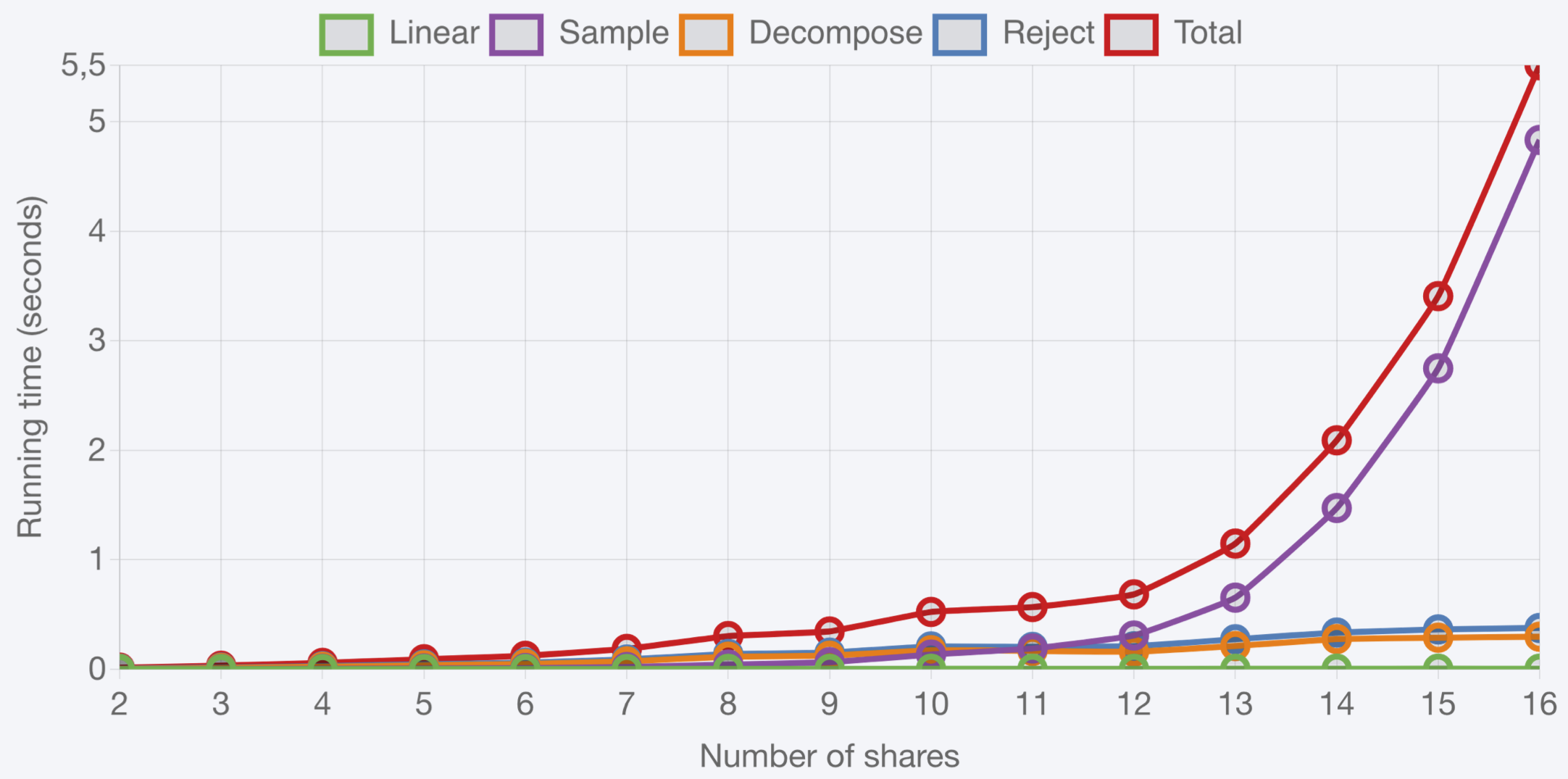
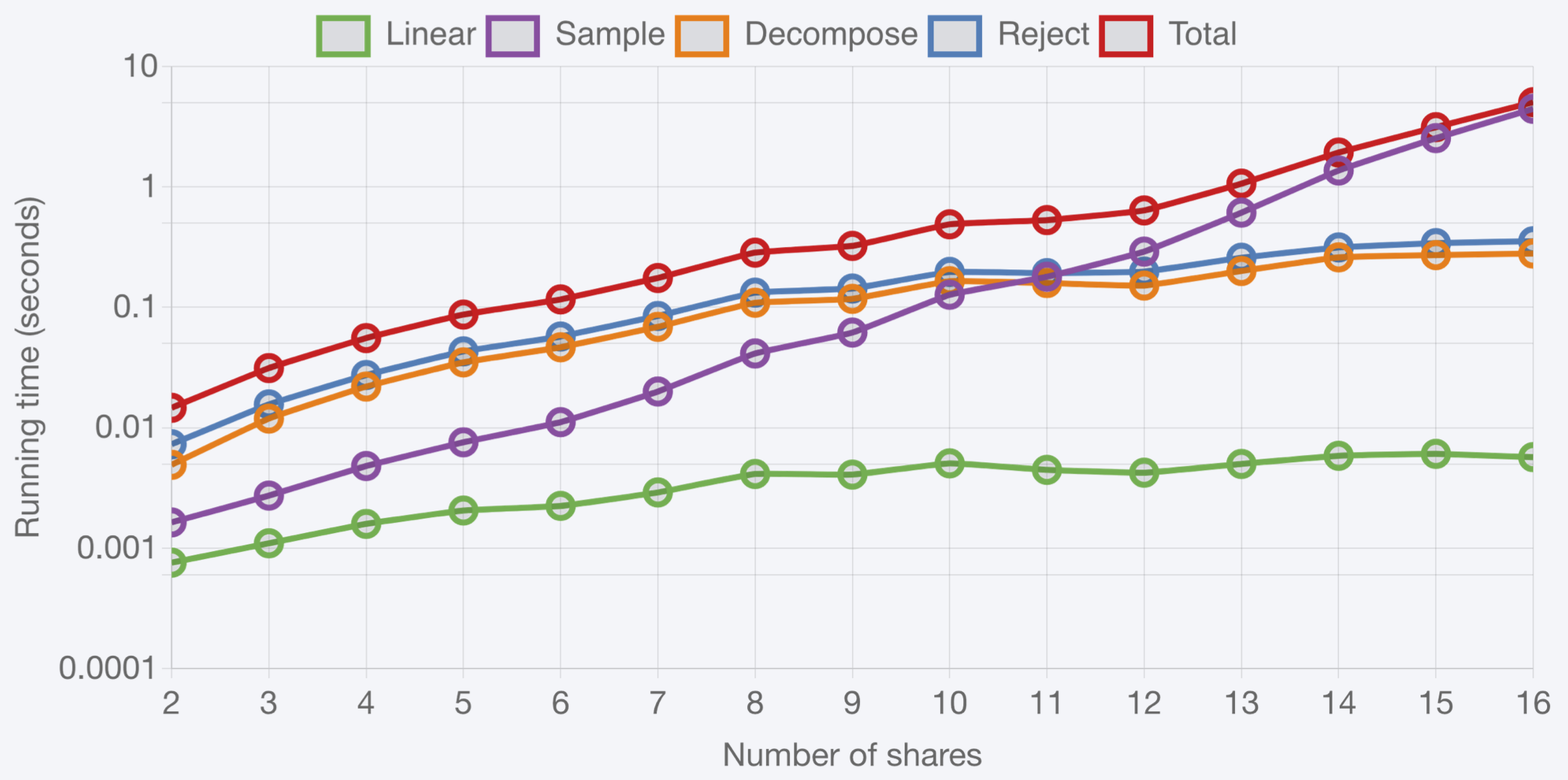
The Steps 1 [Sample] and 6 [Reject] suffer from similar issues. Simply put, there is no known way to mask Dilithium without using expensive mask conversions. The blow-up in running time when masking Dilithium makes it unrealistic to reach high masking orders. s illustrated below using an open source implementation (Git Hub) from a recent paper by researchers at IDEMIA and Université du Luxembourg (TCHES). These numbers were obtained on a desktop with Intel Core i7 7700T @ 2.9 GHz. We can see in these graphs that [Decompose], [Reject] and especially [Sample] make up most of the cost of masked Dilithium.
Raccoon: a masking-friendly PQC signature
In summer 2021, the side-channel limitations of Dilithium were already well-documented. This motivated my colleague Rafael and myself to try and come up with an alternative design. At first, this seemed difficult as three steps ( [Sample], [Decompose], [Reject] ) were difficult to mask, and changing or removing any of these three steps in isolation seemed to render the scheme insecure.
A breakthrough in the design
Our first breakthrough came in fall 2021, when we realized that we needed to consider these three steps together, with [Reject] being the key step tying them all together.
[Reject] was here to enforce a security notion called the ”zero-knowledge” property using a so-called “rejection sampling” security argument.
We realized that by carefully adjusting parameters, one could remove [Reject] and still preserve the zero-knowledge property, by making a different analysis based on the Rényi divergence, a proof technique that had done wonders in the past for lattice-based cryptography, and which I had used back in 2017 to improve the efficiency of the Falcon signature scheme (ASIACRYPT).
Removing [Reject] created a domino effect. First, our Rényi divergence proof strategy made it completely unnecessary to mask [Decompose].
While [Sample] still needed to be masked, our proof technique was very flexible in this regard, which allowed us to come up with new algorithmic techniques that allowed us to perform [Sample] very efficiently.
Building Raccoon at PQShield
While we got the skeleton of a scheme, we needed to turn this into a polished scheme. Fortunately for us, we had many colleagues at PQShield who excelled at what we needed.
Markku is highly skilled in highly efficient and secure embedded implementations, Shu and Mary are experts in security proofs, Thomas Espitau is savvy in lattice cryptanalysis and parameter selection, and Fabrice (now at XWIKI) has a good transverse understanding of all these aspects.
Outside PQShield, we enlisted the help of Mélissa Rossi (ANSSI), an expert in security proofs for masking schemes. By combining the skills and ideas of this team of great people, we submitted to the NIST PQC call for additional signatures
This is a scheme, Raccoon, that can be masked at high orders with minimal overhead, and orders of magnitude faster than Dilithium, as illustrated in this final figure: even with 8 shares, our unoptimized implementation of masked Raccoon is already 50 times faster than the optimized implementation of masked Dilithium.

Why is it called Raccoon?
One of the most distinctive features of raccoons is the “mask” around their eyes. Thus we called our scheme Raccoon as a nod to its masking-friendly nature. If you want to read more about Raccoon, have a look at our website, NIST PQC specification and implementations!
Learn More About Raccoon and Side Channel Attacks
If you’d like to learn more about Raccoon, side channel attacks, or PQShield’s post-quantum cryptography research, explore our Raccoon resources, or get in touch with our team.
Frequently Asked Questions
What are side channel attacks?
Side channel attacks exploit physical information leakage from devices, such as timing, power consumption, electromagnetic emissions or acoustic signals, to recover sensitive cryptographic information.
Why are side channel attacks important for post-quantum cryptography?
Although post-quantum algorithms are mathematically secure, their implementations can still leak information through physical side channels. Protecting implementations is therefore just as important as selecting secure algorithms.
What is masking?
Masking is a cryptographic countermeasure that splits sensitive values into multiple random shares. This makes it significantly more difficult for attackers to recover secret information through physical observations.
Why is Dilithium difficult to mask?
Several stages of the Dilithium signing process require expensive mask conversions between arithmetic and Boolean masking, making high-order masking computationally expensive.
How does Raccoon improve protection against side channel attacks?
Raccoon was specifically designed to simplify masking by removing several expensive operations required by Dilithium, enabling much higher masking orders with significantly lower performance overhead.