

Key Takeaways
- PQShield has launched UltraPQ-Suite, a portfolio of specialized post-quantum cryptography solutions for real-world deployment.
- PQPlatform-TrustSys provides a PQC-first Root of Trust solution for ASIC and FPGA hardware.
- The suite is designed to support compliance with NIST standards and requirements such as NSA CNSA 2.0.
- Ultra-fast, ultra-secure and ultra-small implementations address different performance, security, and footprint requirements.
- FIPS 140-3 certification supports production-ready deployment of quantum-safe cryptography.
UltraPQ Suite: Post-Quantum Cryptography Solutions for Real-World Deployment
PQShield is proud to announce the launch of an updated suite of post-quantum cryptography solutions, beginning with PQPlatform-TrustSys.
This new quantum-safe Root of Trust solution is designed to help ASIC and FPGA hardware meet emerging PQC requirements, including standards and regulations such as the NSA’s CNSA 2.0.
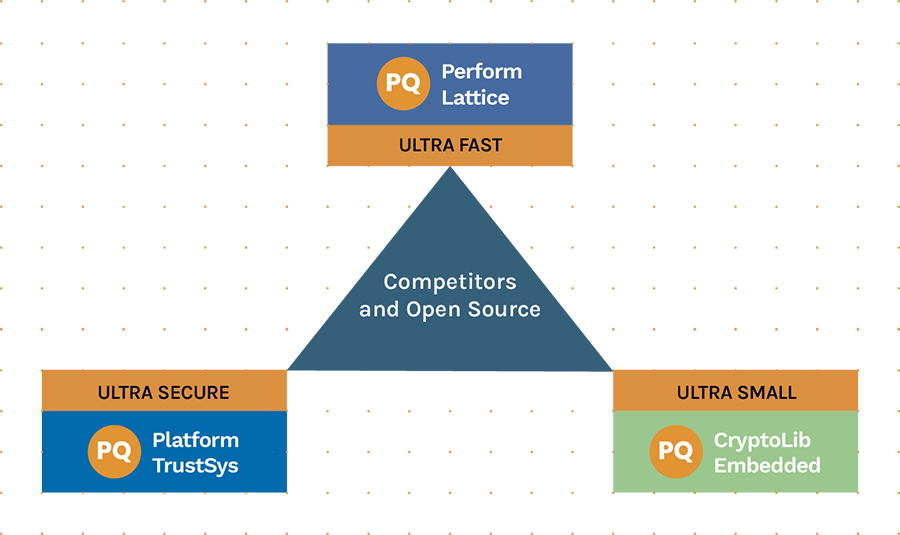
PQPlatform-TrustSys sits within the ultra-secure pillar of the UltraPQ-Suite. The suite brings together ultra-fast, ultra-small and ultra-secure implementations of PQC for critical use cases as the global technology supply chain transitions to new cryptographic standards.
Specialized PQC Implementations for a Post-Standards World
Different environments place very different demands on post-quantum cryptography. Manufacturers may require maximum performance, stronger implementation security, or an exceptionally small memory and hardware footprint.
The UltraPQ-Suite is structured around three pillars:
- Ultra-fast for high-performance applications
- Ultra-secure for systems facing sophisticated attacks
- Ultra-small for constrained devices and embedded environments
This enables organizations to select PQC implementations that match their technical and operational priorities.
Ultra Fast
Ultra-fast implementation provides high-performance PQC for applications where speed, latency, and power efficiency are critical. PQPerform-Flare is the core product in this category. It optimizes key encapsulations per second while maintaining strong latency performance and efficient power consumption.
This is particularly important for networking applications such as:
- Firewalls
- Routers
- Hardware Security Modules (HSMs)
- High-throughput network infrastructure
Ultra Secure
Ultra-secure implementations are designed for products that may be targeted by sophisticated attackers. This includes critical infrastructure and long-lifecycle devices where security and integrity need to be maintained for many years.
Protection Beyond the Algorithm
Side-channel attack (SCA) and fault injection attack (FIA) resistance are central to this category.
These protections are particularly important for device attestation. Systems need to establish that a device has not been tampered with or compromised and is not running unauthorized firmware or software.
PQPlatform-TrustSys is the leading product within this pillar. A range of modular IPs can also help future-proof existing security implementations.
Ultra Small
Our ultra-small implementation is designed for memory-constrained devices, embedded systems, microcontrollers, and equipment already deployed in the field.
Typical applications include:
- Energy smart meters
- Industrial controls
- Embedded IoT devices
- Constrained microcontrollers
PQMicroLib provides a highly compact implementation of PQC for these environments.
It is particularly useful for OEMs and device manufacturers that need efficient cryptography to secure end-to-end encrypted communications while maintaining data confidentiality and integrity.
Standards-Aligned PQC Implementation
Deploying post-quantum cryptography involves more than supporting a new algorithm. Implementations must account for standards, deployment environments, cryptographic protocols, and implementation-level threats.
Our experience with global PQC standards, cryptographic algorithms, patented technologies, and security techniques helps support production-ready deployment.
Solutions are tested for cloud, edge, lab and government-grade applications, with alignment across frameworks and certifications including:
- NIST
- Common Criteria
- SESIP
- PSA
Introducing PQPlatform-TrustSys: a PQC-first Root of Trust
In 2024, the PKfail vulnerability highlighted security weaknesses affecting Secure Boot and Secure Update mechanisms. These mechanisms play a fundamental role in protecting devices against malware and unauthorized software.
As cryptographic requirements transition to PQC, Secure Boot and Secure Update architectures will also need to evolve.
Regulatory Timelines and the RSA Phase-Out
Product developers need to account for both existing and emerging regulatory requirements.
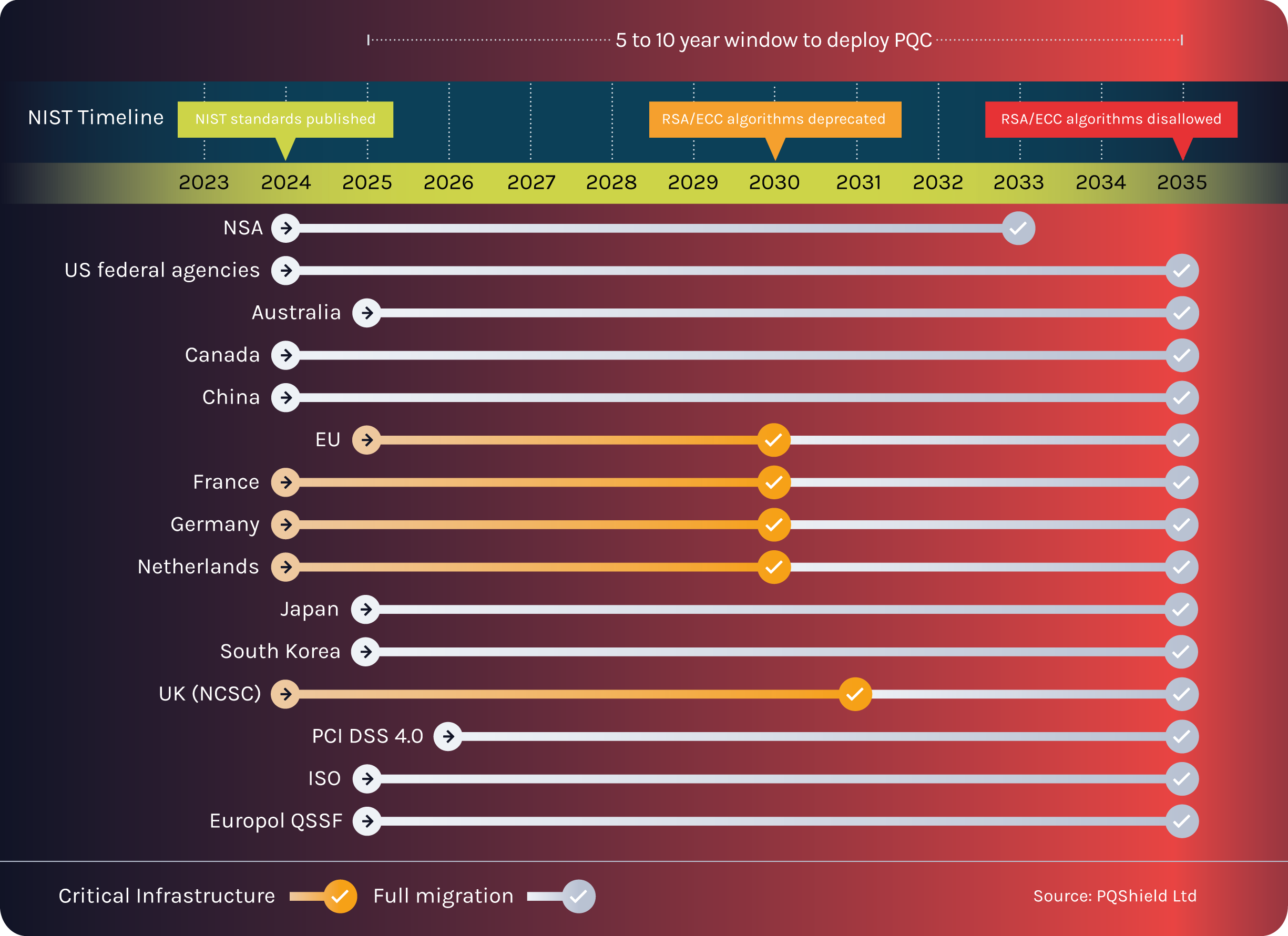
NIST has outlined transition timelines for post-quantum cryptography, including the planned phase-out of RSA by 2035. For manufacturers developing products with long lifecycles, these timelines make early implementation planning increasingly important.
Designed for Compliance and Efficient Integration
PQPlatform-TrustSys is designed to help manufacturers address these requirements with minimal integration time and effort. Its PQC-first architecture supports efficient quantum-resistant security without relying on the limitations of legacy cryptographic architectures.
This allows ASIC and FPGA developers to build post-quantum capabilities into products from the outset.
Advanced Key Management
Large-scale cryptographic deployments also depend on effective key management.
PQPlatform-TrustSys tracks:
- Key origin
- Key permissions
- Key revocation
These capabilities help control how cryptographic keys can be used throughout the system.
The Root of Trust can enforce restrictions on critical operations and maintain security even if the host system is compromised. Key origin and permission attributes can also be extended to cryptographic accelerators connected through a Private Peripheral Bus.
Protection Against Physical and Side-Channel Attacks
Many ASIC and FPGA implementations are physically accessible.
This includes hardware used in:
- Consumer devices
- Automotive systems
- Communications networks
- Industrial equipment
Physical access can expose systems to side-channel attacks that exploit timing, power consumption or fault behavior. Secure PQC implementations therefore need to consider both mathematical security and resistance to implementation-level attacks.
Addressing the PQC Implementation Challenge
Ali El Kaafarani, PQShield founder and CEO:
“With new standards announced, last year was pivotal in the progress towards quantum security. 2025 is where we run into the real challenge: implementation. Given the wide range of implementation use cases, we need to offer manufacturers enough flexibility and crypto-agility to roll out PQC in a way that meets their priorities.
“I am proud to be launching PQShield’s UltraPQ-Suite to help the supply chain on this journey. Our ultra secure, ultra fast and ultra small products address the major challenges manufacturers face when choosing an implementation of PQC, enabling them to more easily protect the next generation of devices and digital infrastructure that reaches the market.”
The challenge is shifting from algorithm selection towards secure, efficient implementation. Manufacturers must now determine how PQC fits within real-world constraints such as performance, memory, power, silicon area and product lifecycle.
Supporting the Global Supply Chain
Dr Axel Poschmann, VP of Product Security & Innovation:
“I am excited to introduce PQPlatform-TrustSys to support ASIC and FPGA manufacturers in bringing quantum-safe products to market. This hardware holds a critical role in the global technology supply chain, and by assisting its adoption of post-quantum cryptography, we can help accelerate the overall global transition to quantum security.”
ASIC and FPGA manufacturers occupy an important position in this transition. Embedding PQC at the hardware level can help create a secure foundation for the devices, networks and infrastructure built on top of it.
Certification and Proven Delivery
The UltraPQ Suite launch follows the achievement of FIPS 140-3 certification through the Cryptographic Module Verification Program (CMVP). CMVP evaluates cryptographic modules and provides government agencies and other organizations with an established security benchmark.
PQShield has also developed its own silicon test chip to demonstrate that standards-ready PQC can be implemented successfully in silicon. Together, these milestones help move PQC from standards and research into practical deployment.
Choosing the Right Post-Quantum Cryptography Solution
There is no single PQC implementation that is right for every environment.
Organizations should consider factors such as:
- Performance and latency
- Memory footprint
- Power consumption
- Hardware resources
- Side-channel resistance
- Fault injection resistance
- Standards and regulatory requirements
- Existing system architecture
- Product lifecycle
Match the Solution to the Use Case
A network appliance may prioritize throughput. A smart meter may need an extremely small memory footprint.
A Root of Trust for critical infrastructure may prioritize implementation-security and resistance to physical attacks. The UltraPQ Suite is designed around these different requirements rather than treating PQC as a one-size-fits-all deployment.
Start Your Post-Quantum Transition with Confidence
The shift to post-quantum cryptography is no longer only a standards exercise. As migration deadlines move closer, organizations need to consider how standardized algorithms will be implemented across real products and infrastructure.
Whether you are developing ASICs, FPGAs, embedded systems or critical infrastructure, PQShield’s UltraPQ-Suite provides options designed around performance, security and implementation-efficiency.
Explore Post-Quantum Cryptography Solutions
Organizations now need to move from considering PQC standards,towards practical implementation across software, hardware and embedded environments.
Get in touch with PQShield today to explore which post-quantum cryptography solutions can best meet your performance, security, compliance and integration requirements.
Frequently Asked Questions
What are post-quantum cryptography solutions?
Post-quantum cryptography solutions are software, hardware and cryptographic implementations designed to protect systems against attacks from future quantum computers while running on today’s infrastructure.
What is UltraPQ Suite?
The UltraPQ Suite is a portfolio of PQC implementations designed around three priorities: high performance, strong implementation security and a small footprint.
What is PQPlatform-TrustSys?
PQPlatform-TrustSys is a PQC-first Root of Trust solution for ASIC and FPGA hardware. It provides cryptographic acceleration, key management, and security controls for quantum-resistant platforms.
How can PQC be implemented in constrained devices?
Optimized software libraries can reduce memory and processing requirements. PQMicroLib-Core is designed specifically for embedded systems, microcontrollers, and other constrained environments.
Why do PQC implementations need side-channel protection?
Attackers can target physical implementations rather than the cryptographic algorithm itself. Side-channel and fault injection resistance help protect keys and cryptographic operations against these attack techniques.