

Key Takeaways
- NIST has officially released its post-quantum cryptography standards
- NIST post quantum cryptography standards will reshape global cybersecurity
- FIPS 203, 204, and 205 define the next generation of encryption
- Organisations must begin transitioning to PQC-compliant systems
- PQShield delivers solutions built on the latest NIST standards
The new NIST PQC Standards are here!
The long-awaited NIST post quantum cryptography standards have officially been published.
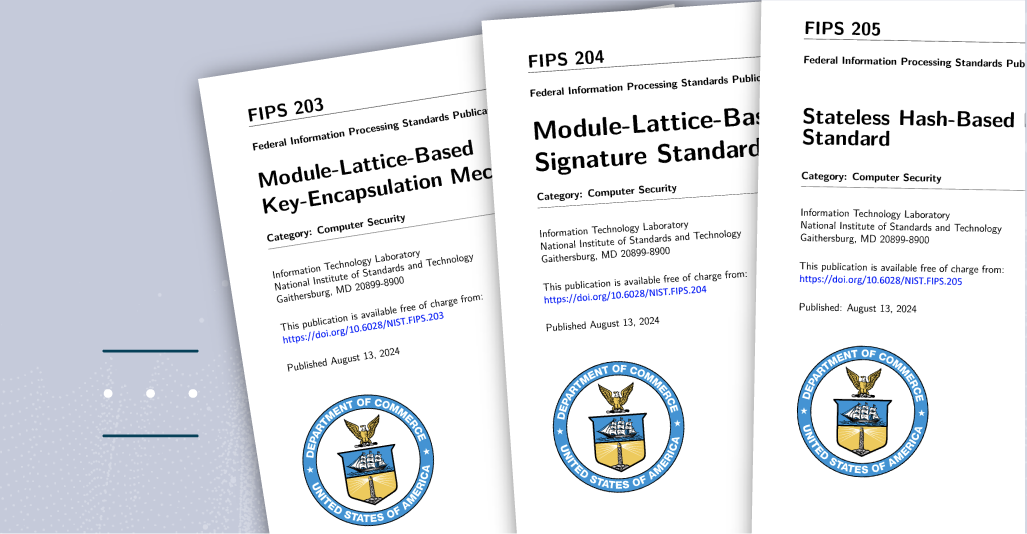
Today, NIST, the US National Institute of Standards and Technology, published their finalized post-quantum cryptography (PQC) standards, FIPS 203, FIPS 204, and FIPS 205, marking the culmination of an eight-year cycle of submission, research, and analysis.
This announcement represents a major milestone for cybersecurity and signals the beginning of a large-scale transition to quantum-safe cryptography.
What are the New NIST Standards?
This long-awaited announcement marks a significant milestone in the history of Post Quantum Cryptography. It’s set to impact the cryptography deployed in every industry, from machines transferring data across a network, online financial transactions, or connectivity in military devices.
As a result of today’s news, chips, devices, software applications, and components in supply chains will now need to be PQC-compliant with the framework of standards announced.
The three core standards are:
| Standard | Description | AKA | Document |
|---|---|---|---|
| FIPS 203 | Module-Lattice-Based Key-Encapsulation Mechanism Standard | Kyber | https://nvlpubs.nist.gov/nistpubs/fips/nist.fips.203.pdf |
| FIPS 204 | Module-Lattice-Based Digital Signature Standard | Dilithium | https://nvlpubs.nist.gov/nistpubs/fips/nist.fips.204.pdf |
| FIPS 205 | Stateless Hash-Based Digital Signature Standard | SPHINCS+ | https://nvlpubs.nist.gov/nistpubs/fips/nist.fips.205.pdf |
A fourth digital signature standard FN-DSA (FALCON) will follow shortly, in addition to two other recommended hash-based schemes, XMSS and LMS, previously covered in NIST SP 800-208.
These selected standards are the submissions that have shown the highest level of security provable with an acceptable performance. They have been chosen for robustness, flexibility, and usefulness in a variety of situations, and are based on technology that combines both lattice-based cryptography, and hash-based schemes.
What will be the impact of this announcement?
Adoption of the new standards is likely to be both fast and widespread.,
Guidance from security bodies such as the NSA, alongside equivalent organisations including Germany’s BSI, France’s ANSSI, and the UK’s NCSC, reinforces the urgency of transition.
In the US, the Quantum Computing Cybersecurity Preparedness Act further strengthens the push towards PQC migration, focusing agencies on transitioning critical systems.
This growing regulatory momentum highlights the importance of aligning with NIST post quantum cryptography standards as part of long-term security strategy.
A major milestone for cybersecurity
There’s little doubt that today’s announcement triggers the biggest and most significant cybersecurity transition in history.
As PQShield CEO and Founder Ali El Kaafarani explains,
“This is an exciting moment for cryptographers like Team PQShield, who worked to shape the new standards. It’s now our duty and responsibility to get the new software and hardware designs into the hands of more organizations, so they can keep us all one step ahead of the attackers.”
PQShield continues to play a leading role in bringing these standards into real-world implementation.
PQShield and the new standards
PQShield’s security suite of post-quantum hardware and software products is built on these new standards, and we’ve focused on high-performance, versatility, security, and efficiency.
It’s our mission to update the legacy components in the world’s technology supply chain, and with NIST announcing today, we’re perfectly poised.
Our UltraPQ suite supports FIPS 203, FIPS 204, and FIPS 205, helping organisations adopt NIST post quantum cryptography standards with confidence.
PQShield product suite
| Family | Product | Description |
|---|---|---|
| Embedded Software IP | PQMicroLib-Core | Highly optimizable baremetal PQC library in under 13kb RAM with option to include DPA protection |
| System Level Software IP | PQCryptoLib-Core | Highly configurable software PQC library for traditional, PQC and PQ/T hybrid |
| PQCryptoLib-SDK | PQCryptoLib-Core + OpenSSL 3.x provider for ease of integration | |
| Platform Security Hardware IP | PQPlatform-CoPro | Highly configurable hardware PQC acceleration for subsystems, from hash only to PQ/T, with SCA and FIA |
| PQPlatform-TrustSys | Highly configurable autonomous hardware PQC acceleration with RISC-V processor for full CPU offload | |
| Performance Hardware IP | PQPerform-Flare | Single instance hardware lattice PQC ultra accelerator as an AXI subordinate |
| PQPerform-Inferno | Highly configurable hardware lattice PQC ultra accelerator in AXI-4 and PCIe based systems – from core only to multi-instance | |
| PQPerform-Flex | Enhanced cryptoagility with PQPerform-Inferno and RISC-V processor |
Preparing for adoption
With the release of NIST post quantum cryptography standards, organisations should begin planning their transition now.
This includes understanding where cryptography is used, assessing risks, and preparing systems for integration of quantum-safe algorithms.
The future of NIST post quantum cryptography standards
The introduction of NIST post quantum cryptography standards signals the beginning of a new era in cybersecurity.
As adoption accelerates, organisations that act early will be better positioned to meet regulatory requirements and secure their systems against future threats. PQShield is ready to support this transition every step of the way.
Ready to adopt NIST post quantum cryptography standards?
Contact PQShield today and to explore solutions and begin your transition to quantum-safe security today.