

Key takeaways
- Secure messaging apps rely on cryptography that quantum computers will eventually break
- Quantum secure communication is essential to protect private messages in the future
- Post-quantum cryptography offers a practical path forward today
- PQShield has published concrete recommendations for securing Signal-style messaging
- Open collaboration is key to keeping secure communication accessible to everyone
Why quantum secure communication matters for everyday messaging
The widespread adoption of smartphones in the last decade has brought with it a meteoric rise in the use of secure messaging apps. Over 2 billion people used WhatsApp in January 2022, while 40 million people used Signal.
However secure these messaging apps are today, large-scale quantum computers will soon have the processing power to break the end-to-end encryption they rely on to keep messages private. This looming shift makes quantum secure communication not a theoretical concern, but an urgent, real-world challenge.
Why quantum computing changes everything
That’s a big problem.
“Secure messaging is how many businesses communicate, how whistleblowers share truth with journalists, and how family and friends connect across borders,” says our CEO, Ali El Kaafarani. “It’s become an almost fundamental right for much of the global population.”
The arrival of cryptographically relevant quantum computers threatens the public-key algorithms that underpin today’s secure messaging. Without preparation, the privacy guarantees people rely on could quietly disappear.
PQShield’s recommendations for secure messaging
To address this challenge, PQShield has published new recommendations on how to protect secure messaging in a post-quantum world.
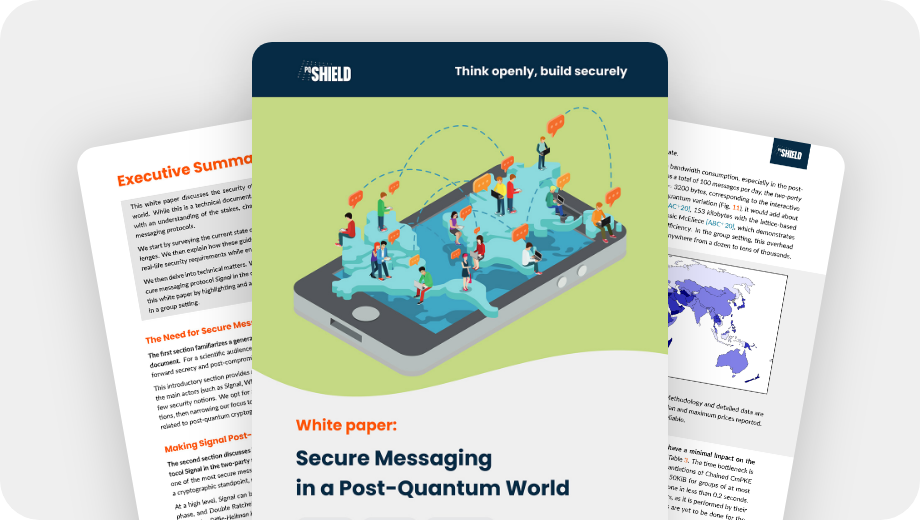
In a newly released white paper, researchers at PQShield outline how post-quantum cryptography can be applied to the Signal secure messaging protocol in a two-person setting. The paper also explores how these approaches could be extended to group messaging, which is an area that introduces additional complexity around key management, scalability, and performance.
This work demonstrates how quantum secure communication can be achieved using practical, standards-aligned cryptographic techniques that are ready to be deployed.
Supporting open, private communication
As part of this effort, PQShield is offering to license its end-to-end encrypted messaging intellectual property to the Signal Foundation on a pro bono basis. The goal is to support Signal’s mission of making secure communication accessible to everyone, even in the face of emerging quantum threats.
“We’re proud to offer this advisory for free, so private communication can remain accessible to all,” says Ali.
By working openly with non-profits and standards bodies, PQShield aims to ensure that quantum secure communication is not limited to a privileged few, but becomes a shared global capability.
Looking ahead
Quantum computing is advancing rapidly, and the transition to post-quantum cryptography will take time. Acting now gives messaging providers, platforms, and users the best chance to preserve trust and privacy in the long term.
For organisations building or relying on secure messaging, preparing for quantum secure communication today is one of the most important steps they can take to protect users tomorrow.
Want to learn more?
To learn more about post-quantum cryptography, secure communications, and how PQShield is helping organisations prepare for the quantum era, get in touch with our team today.
Further Reading:
- https://www.helpnetsecurity.com/2022/09/07/post-quantum-cryptography-signal-protocol/
- https://www.marketwatch.com/press-release/pqshield-publishes-post-quantum-upgrade-to-the-signal-protocol-and-offers-it-pro-bono-to-the-signal-foundation-2022-09-07-3203148?mod=search_headline
Frequently Asked Questions
What is quantum secure communication?
Quantum secure communication refers to communication systems designed to remain secure even when quantum computers become capable of breaking today’s cryptographic algorithms. This typically involves the use of post-quantum cryptography, which is resistant to quantum attacks.
Why are current messaging apps vulnerable to quantum computers?
Most secure messaging apps rely on public-key cryptography such as RSA or elliptic-curve cryptography. These algorithms can be broken by sufficiently powerful quantum computers using known quantum algorithms.
What is post-quantum cryptography?
Post-quantum cryptography consists of cryptographic algorithms designed to run on classical computers but remain secure against both classical and quantum attacks. PQShield focuses on developing, implementing, and standardising these algorithms.
Is post-quantum cryptography ready to use today?
Yes. Many post-quantum algorithms are already being standardised and tested. PQShield works closely with global standards bodies and industry partners to support real-world deployment today, not just in the future.
How does PQShield help organisations prepare for the quantum era?
PQShield provides post-quantum cryptographic solutions, advisory services, and implementation support to help organisations transition safely to quantum-resistant security across messaging, infrastructure, and embedded systems.