

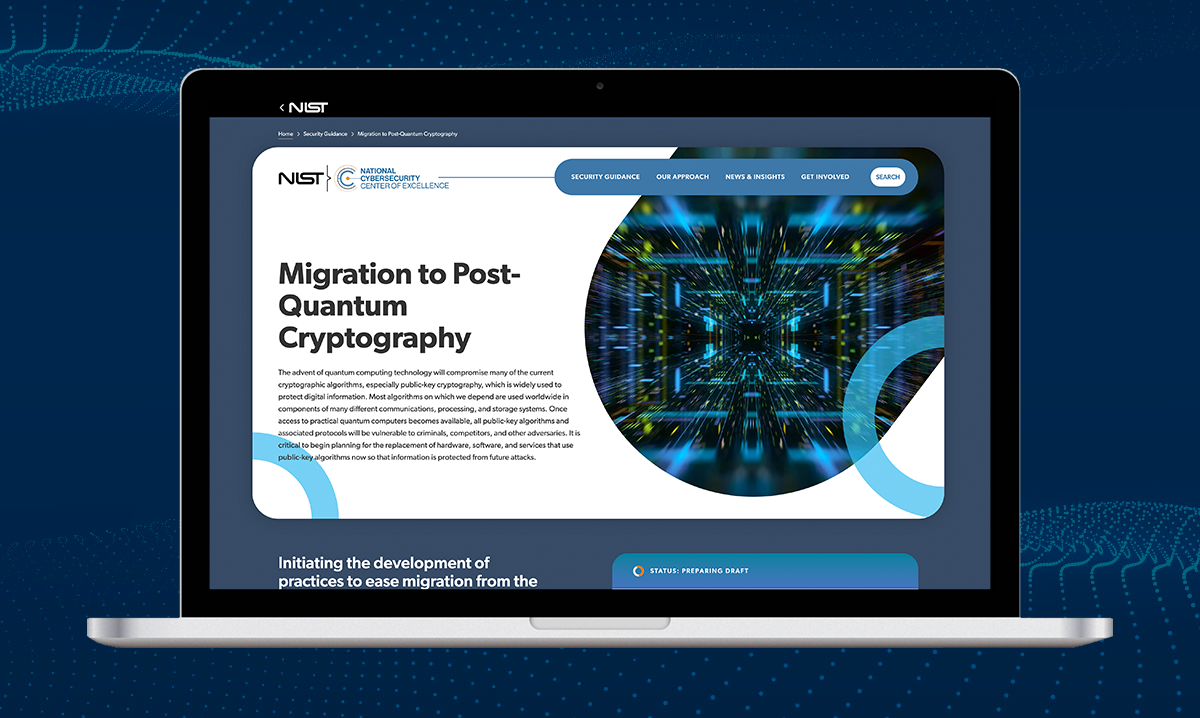
Supporting real-world migration to post-quantum cryptography
As organisations prepare for the transition away from vulnerable public-key cryptography, quantum resistant security has become a practical and urgent concern, not a theoretical one. Moving to post-quantum cryptography requires more than selecting new algorithms; it demands tools, guidance, and implementation frameworks that work in real-world systems.
In this blog, we explore PQShield’s collaboration with the US National Cybersecurity Center of Excellence (NCCoE), how this work supports NIST’s post-quantum cryptography standardisation efforts, and why practical deployment is central to achieving long-term cryptographic resilience across software, hardware, and communications infrastructure.
PQShield Collaborates with NCCoE
PQShield is pleased to announce that it has entered into a Cooperative Research and Development Agreement (CRADA) with the National Cybersecurity Center of Excellence to develop practices that ease the migration from current public-key algorithms to post-quantum cryptography.
This collaboration focuses on helping organisations navigate the complex transition required to achieve quantum resistant security, particularly in environments where cryptography is deeply embedded across systems, protocols, and devices.
The NCCoE Migration to Post-Quantum Cryptography Project
The NCCoE – cybersecurity division of the National Institute of Standards and Technology (NIST) – launched the Migration to Post-Quantum Cryptography project to demonstrate tools that can assist the process of crypto-discovery.
Leveraging public and private collaborative consortium, the project also addresses the broader real-world challenges of using post-quantum cryptographic algorithms in the protocols used today to protect communications and information.
PQShield’s role in practical implementation
As part of the NCCoE project, PQShield will focus on real-world deployment challenges. This work draws on PQShield’s team of specialist cryptographers and engineers, as well as experience supporting customers such as Microchip Technology, Collins Aerospace, and Kudelski Security.
The aim is to demonstrate how quantum-resistant cryptography can be integrated into existing and emerging systems, including software, hardware, and advanced communication protocols, without disrupting performance, security, or compliance requirements.
Alignment with NIST’s Post-Quantum Standards
The NCCoE Migration to Post-Quantum Cryptography project complements NIST’s ongoing process to standardise quantum-resistant public-key cryptographic algorithms.
In May 2022, NIST announced the first four quantum-resistant algorithms selected for standardisation as part of its post-quantum cryptography programme. All four included contributions from PQShield, reinforcing the company’s role in shaping both the theoretical foundations and practical deployment of post-quantum cryptography.
You can read our full press release here.
Why This Matters for Organisations Today
Preparing for post-quantum cryptography is no longer a future-only exercise. Organisations must begin understanding where cryptography is used across their systems, which assets are at risk, and how migration can be achieved without introducing operational disruption.
By combining standards development, applied research, and real-world implementation guidance, collaborations like the PQShield and NCCoE CRADA help translate post-quantum readiness into actionable security strategies.
Next Steps
If you are assessing how to implement quantum resistant security across your organisation, PQShield works with industry, governments, and standards bodies to support secure, practical, and scalable post-quantum cryptographic deployments.
Get in touch with PQShield to explore how post-quantum cryptography can be integrated into your systems today.
Frequently Asked Questions
What is quantum resistant security?
Quantum resistant security refers to cryptographic systems designed to remain secure against attacks from quantum computers. This typically involves post-quantum cryptographic algorithms that are resistant to quantum-based attacks on public-key cryptography.
Why is migration to post-quantum cryptography challenging?
Migration is complex because cryptography is embedded across software, hardware, protocols, and long-lived systems. Organisations must identify where cryptography is used, assess risk, and transition without breaking interoperability or performance.
How does PQShield support quantum resistant security?
PQShield supports quantum resistant security through algorithm design, implementation tooling, cryptographic libraries, and deployment expertise across software, hardware, and embedded systems.
What is the role of NIST and NCCoE in post-quantum cryptography?
NIST leads the standardisation of post-quantum cryptographic algorithms, while the NCCoE focuses on practical implementation guidance, reference architectures, and real-world deployment scenarios.
When should organisations start preparing for post-quantum migration?
Preparation should begin now. Crypto-discovery, inventory, and migration planning can take years, especially for regulated or infrastructure-heavy environments.