

Abstract
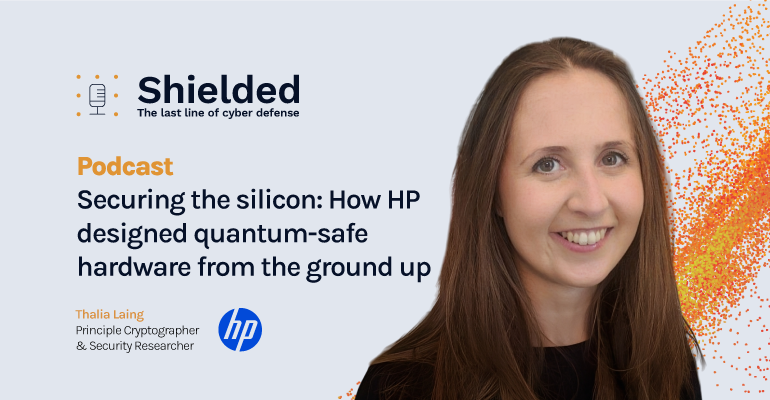
As quantum computing advances, organisations can no longer treat hardware migration as a secondary task. Thalia Laing, Principal Cryptographer at HP Security Lab, explains how HP adopted a hardware-first approach to post-quantum security by launching the world’s first quantum-safe Secure Boot for business PCs ahead of NIST standards. She describes how HP integrated hybrid RSA + LMS signatures to preserve certification assurance and user performance while adding quantum-safe protection at power-on. Thalia outlines the operational design behind LMS state management, parameter selection, and cross-team testing to ensure verification speed and long-term reliability. She details why many enterprises overlook hardware-implemented cryptography in their inventories and how this blind spot undermines migration plans. She highlights how securing firmware integrity extends device lifespan and builds measurable confidence across product lines. The discussion reinforces that protecting the hardware root of trust is the first step toward true post-quantum resilience.
What You’ll Learn
- How HP built quantum-safe Secure Boot into production PCs before PQC standards were finalised.
- Why hybrid RSA + LMS signatures bridge certification and quantum resilience.
- How LMS state and parameters are managed for predictable, verifiable signing.
- Why hardware-level cryptography must be included in every crypto inventory.
- How securing firmware integrity extends device lifetime and compliance value.
- How to prioritise long-lived, hard-to-update products in PQC migration plans.
- Why crypto agility begins in design, not deployment.
- Why starting with the hardware root of trust reduces cost, risk, and time pressure later.
Thalia Laing is the Principal Cryptographer and Security Researcher at HP Security Lab, where she leads research and implementation initiatives in post-quantum cryptography, hardware-based security, and trusted computing. She has played a key role in HP’s development of quantum-safe Secure Boot for business PCs and printers, integrating hybrid RSA + LMS architectures that strengthen firmware integrity and protect devices throughout their lifecycle. Over nearly eight years at HP, she has contributed to advancing cryptographic standards, security innovation, and enterprise readiness for the quantum era.
Thalia holds a PhD in Cyber Security from Royal Holloway, University of London, where her research on enhanced threshold schemes explored the balance between security and efficiency in distributed cryptographic systems. A member of the NIST NCCoE Migration to PQC Project, she continues to collaborate across industry and academia to accelerate the adoption of quantum-resistant security technologies. Known for her rigour and clarity in applying cryptography to real-world engineering, Thalia focuses on designing security foundations that endure across generations of hardware and emerging post-quantum standards.
……………………………………….
Want exclusive insights on post-quantum security? Stay ahead of the curve—subscribe to Shielded: The Last Line of Cyber Defense on…