

Preparing UK businesses for the post-quantum era
Key takeaways
- Quantum computing is accelerating faster than many organisations expected, creating urgent implications for cyber security in quantum computing
- New post-quantum cryptography standards from NIST mark a clear shift from theory to real-world implementation
- Sensitive data encrypted today may be vulnerable to future quantum-enabled attacks
- Major UK banks and regulated industries are already publishing post-quantum security roadmaps
- Early planning allows organisations to reduce risk, manage costs, and transition securely with support from experts like PQShield
Quantum computing and the future of cyber security
The rapid advancement of quantum computing has triggered a global conversation around cyber security in quantum computing, particularly its ability to undermine today’s encryption standards.
Many of the cryptographic systems that protect sensitive data across banking, healthcare,
government and critical infrastructure rely on mathematical problems that classical computers cannot easily solve. Quantum computers change that equation.
As reported by The Times, the race is now on to prevent quantum computers from smashing existing cyber defences, and to ensure that data encrypted today remains secure tomorrow.
Industry insight from PQShield’s leadership
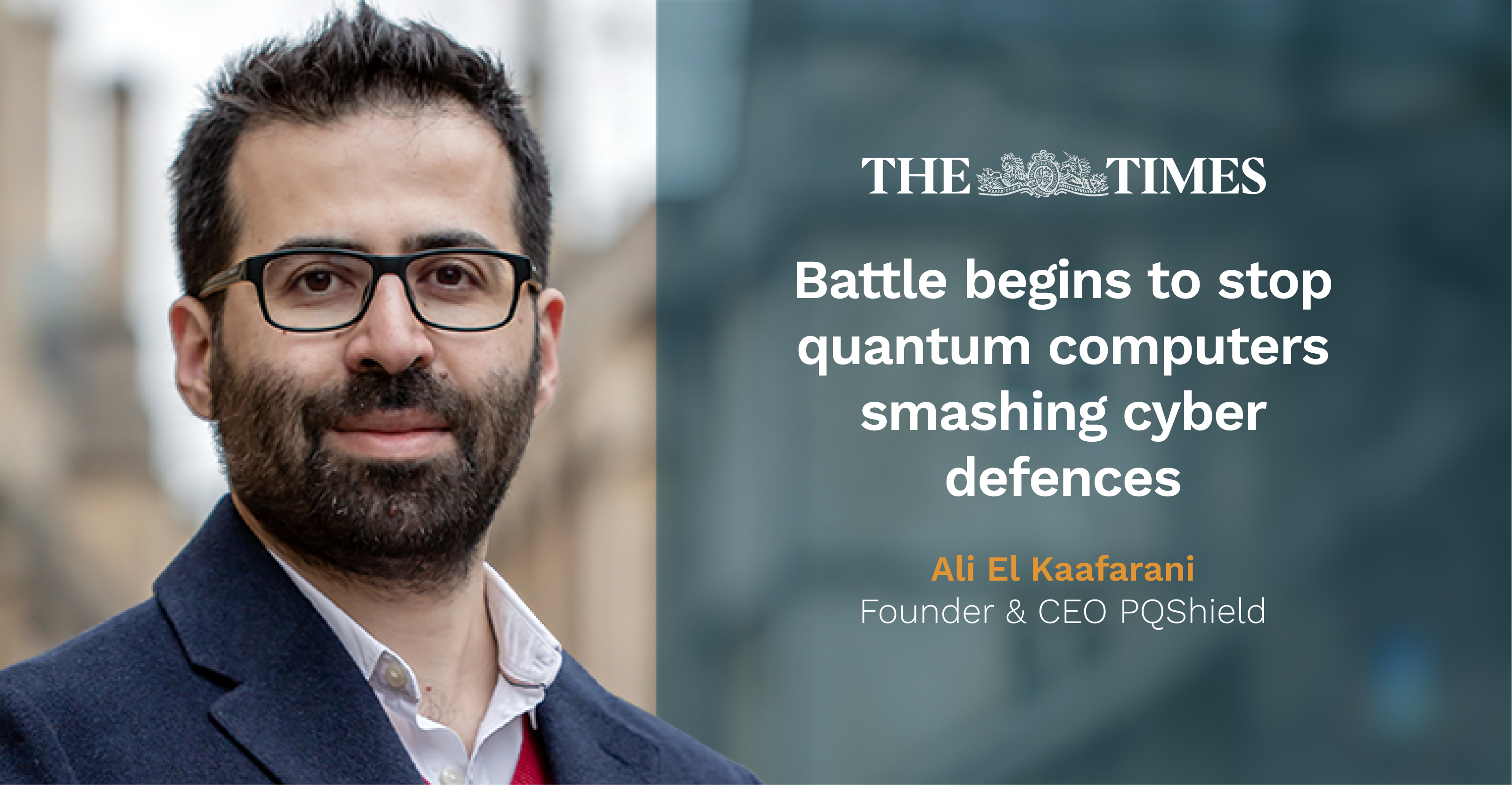
PQShield CEO and Founder, Dr Ali El Kaafarani, recently spoke to The Times about what the newly announced NIST post-quantum cryptography standards mean for businesses across the UK.
According to Ali, the shift is no longer theoretical or optional.
“I don’t have any doubt that in 2025 you will not see any major bank not having published publicly their road map to become post-quantum secure in two, three or four years.”
This signals a critical turning point. Financial institutions are already planning for post-quantum security, and other sectors are expected to follow quickly.
Why NIST’s PQC standards matter
The National Institute of Standards and Technology has now formalised a set of post-quantum cryptographic algorithms designed to withstand attacks from quantum computers.
For organisations, this means:
- Existing encryption methods will eventually become obsolete
- Long-lived data is already at risk from harvest-now, decrypt-later attacks
- Compliance expectations will evolve rapidly across regulated industries
PQShield has played a central role in the development, testing and deployment of post-quantum cryptography, working with governments and enterprises to ensure secure, standards-based adoption.
The real business risk of delaying action
A common misconception is that quantum threats are still decades away. In reality, the risk is cumulative.
Sensitive data encrypted today could be harvested now and decrypted in the future once quantum capabilities mature. This makes cyber security in quantum computing a present-day concern, not a future one.
Organisations that delay assessment and planning may face:
- Regulatory pressure with little time to respond
- Increased migration costs under tight deadlines
- Loss of customer trust if legacy encryption is exposed
PQShield works with organisations to identify cryptographic risk early and build phased migration strategies that reduce disruption.
How organisations should start preparing now
Preparation does not require immediate full-scale replacement of cryptography. Instead, leading organisations are focusing on structured readiness.
Key early steps include:
1. Cryptographic discovery
Understanding where and how cryptography is used across systems, applications and supply chains.
2. Risk assessment
Identifying which data assets require long-term confidentiality and are most exposed to quantum threats.
3. Migration planning
Developing a realistic roadmap aligned with NIST standards and future compliance requirements.
PQShield supports this journey end to end, combining deep cryptographic expertise with practical implementation experience.
Download the full Times article
You can read more insight from Dr Ali El Kaafarani in The Times feature:
- Battle begins to stop quantum computers smashing cyber defences
- A downloadable PDF of the article is available for those who would like to explore the full discussion in detail.
Looking ahead
As quantum technologies accelerate, cyber security in quantum computing will become a core consideration for boards, regulators and security leaders alike. Organisations that act early will be best positioned to protect sensitive data and maintain trust in a post-quantum world.
Speak to PQShield today to understand your cryptographic risk and begin your journey toward post-quantum security with confidence.
Frequently Asked Questions
What is post-quantum cryptography?
Post-quantum cryptography refers to cryptographic algorithms designed to remain secure against attacks from quantum computers. PQShield specialises in developing and deploying these algorithms in line with NIST standards.
Why is quantum computing a threat to current encryption?
Quantum computers can solve certain mathematical problems far more efficiently than classical computers, which could allow them to break widely used encryption methods such as RSA and ECC.
When should organisations start preparing for post-quantum security?
Preparation should begin now. Even if quantum computers are not yet widely available, sensitive data encrypted today may be vulnerable in the future.
Do organisations need to replace all cryptography immediately?
No. PQShield recommends a phased approach, starting with discovery and risk assessment, followed by planned migration aligned to business and regulatory needs.
How does PQShield help organisations become quantum-safe?
PQShield provides cryptographic discovery tools, risk assessments, post-quantum algorithms, and implementation support to help organisations transition securely and efficiently.