

Key Takeaways
- Quantum Key Distribution (QKD) has attracted significant attention as a potential approach to quantum security
- A joint position paper from European security bodies highlights fundamental limitations in QKD
- The paper concludes that QKD is not suitable as a general replacement for classical key agreement
- Post-quantum cryptography (PQC) remains the most viable foundation for quantum safe communication
A practical view of quantum safe communication today
As organisations consider how best to achieve quantum safe communication, an alternative to post-quantum cryptography is the idea of using the quantum effects of photons (or other subatomic particles) to generate a secret key between two parties.
Joint position paper on Quantum Key Distribution
This concept, Quantum Key Distribution (QKD) is thought to be a reliable way to detect any interception or eavesdropping on a channel, and it’s true to say it’s gained some significant attention in the media.
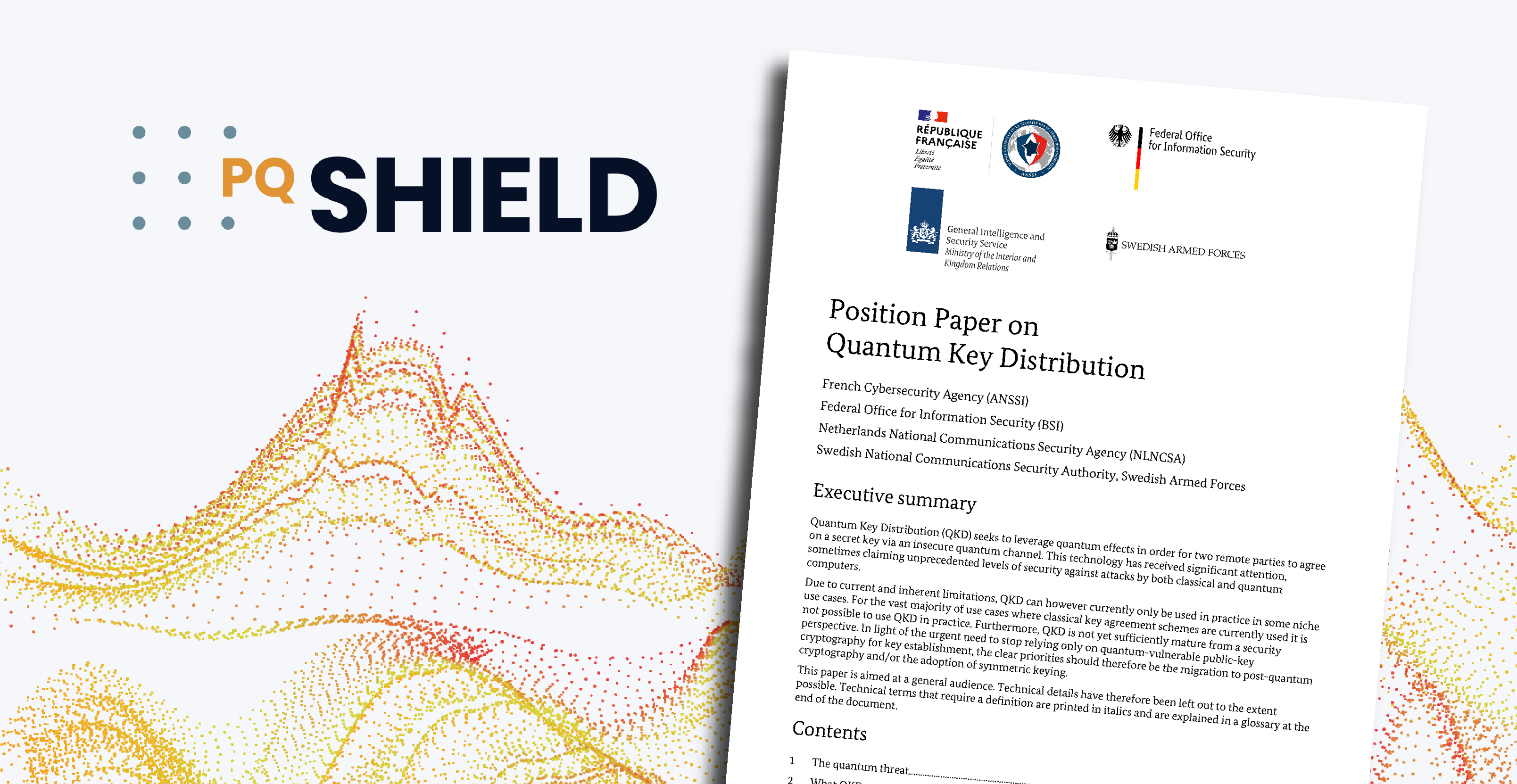
In response, ANSSI, BSI, NLNCSA and the Swedish Armed Forces recently published a joint position paper, outlining their insights into QKD and its relevance to the threat of a quantum computer.
Read the paper here: Position Paper on Quantum Key Distribution, 26.01.24
Position Paper on Quantum Key Distribution
The paper, aimed at a general audience, describes the basic physics behind Quantum Key Distribution. It explains some of the potential use-cases, and points to the theoretical possibility for QKD as a secure defence against a computational attack.
Why QKD falls short in practice
The position paper also draws the conclusion that QKD is both inherently limited, and incapable of providing rigorous end-to-end security at present.
There are a number of reasons why, including distance limitations, physical and practical constraints, the need for a classically shared key, and the lack of comprehensive security proofs that would be necessary to establish a secure QKD protocol.
Why PQC remains the priority
In summary, the position paper suggests that outside niche cases, QKD is not suitable as a replacement for classical key agreement schemes, this is in contrast to the mathematical approach of post-quantum cryptography.
This confirms our view that the primary focus for quantum security should remain on PQC.
What this means
As quantum threats move from theory to reality, organisations need security approaches that are scalable, provable and deployable across real-world systems.
If you are assessing your approach to quantum safe communication, now is the time to focus on practical, PQC-based strategies that can be implemented today.
If you would like support assessing your current position, understanding where PQC fits into your systems, or planning a roadmap toward quantum resilience, get in touch with the team at PQShield. We can help you move from awareness to action with confidence.
Frequently Asked Questions
What do we mean by quantum safe communication?
When we talk about quantum safe communication, we mean protecting data and communications against future threats from quantum computers.
This involves using cryptographic approaches that are designed to remain secure even when quantum computing capabilities mature, ensuring long-term confidentiality and integrity of sensitive information.
Why do we focus on post-quantum cryptography rather than QKD?
We focus on post-quantum cryptography (PQC) because it offers a practical, standards-based approach to quantum resilience. Unlike Quantum Key Distribution, PQC can be deployed across existing digital infrastructure without the need for specialised hardware or physical constraints.
This makes PQC the most scalable and realistic foundation for quantum safe communication in real-world systems.
How does PQShield help organisations prepare for quantum threats?
We help organisations understand their current cryptographic exposure and plan a structured transition to quantum-resistant solutions.
This includes supporting crypto-agility, selecting appropriate PQC algorithms aligned with emerging standards, and integrating them into hardware, software, and cloud environments. Our goal is to make quantum safe communication achievable today, not just in theory.
Are PQShield’s solutions aligned with global standards?
Yes. Our work is closely aligned with international post-quantum cryptography standardisation efforts, including those led by NIST.
Members of our team have been directly involved in the development and evaluation of PQC algorithms, helping ensure that our solutions support secure, future-proof quantum safe communication.
When should organisations start planning for quantum safe communication?
Now. Even if large-scale quantum computers are not yet available, the risk of “harvest now, decrypt later” attacks means data transmitted today could be compromised in the future.
Starting early allows organisations to transition carefully and confidently, rather than reacting under pressure once quantum threats become immediate.